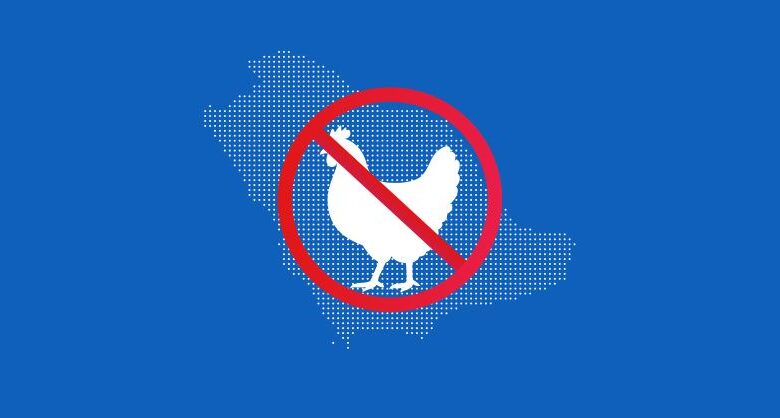
The Saudi Food and Drug Authority (SFDA) has banned the import of poultry and table eggs from 40 countries into the Kingdom of Saudi Arabia and imposed a partial ban on states and regions within 16 other countries, as part of its precautionary measures aimed at protecting public health and enhancing food safety in the local market. The Authority confirmed that the list is subject to periodic review in line with global health developments.
According to the latest update (reviewed by Okaz newspaper), some of the bans have been in place since 2004, while other countries were added progressively over the years based on risk assessments and international reports related to animal diseases—most notably outbreaks of Highly Pathogenic Avian Influenza (HPAI). This reflects an ongoing regulatory approach to monitoring global epidemiological developments.
Under the update, the full ban covers 40 countries: Afghanistan, Azerbaijan, Germany, Indonesia, Iran, Bosnia and Herzegovina, Bulgaria, Bangladesh, Taiwan, Djibouti, South Africa, China, Iraq, Ghana, Palestine, Vietnam, Cambodia, Kazakhstan, Cameroon, South Korea, North Korea, Laos, Libya, Myanmar, the United Kingdom, Egypt, Mexico, Mongolia, Nepal, Niger, Nigeria, India, Hong Kong, Japan, Burkina Faso, Sudan, Serbia, Slovenia, Côte d’Ivoire, and Montenegro.
𝐏𝐚𝐫𝐭𝐢𝐚𝐥 𝐁𝐚𝐧
The partial ban applies to specific states and cities within 16 countries: Australia, the United States, Italy, Belgium, Bhutan, Poland, Togo, Denmark, Romania, Zimbabwe, France, the Philippines, Canada, Malaysia, Austria, and the Democratic Republic of the Congo.
The Authority confirmed that the temporary ban exempts poultry meat and its products that have been heat-treated or otherwise processed in a manner sufficient to eliminate Avian Influenza and/or Newcastle disease viruses, provided they comply with approved health requirements and standard specifications. Such products must be accompanied by an official health certificate issued by the competent authorities in the exporting country, confirming that the product has been heat-treated or otherwise processed to eliminate Avian Influenza/Newcastle disease viruses, without prejudice to the requirement that the product must originate from an approved establishment.













The Saudi Food and Drug Authority (SFDA) has banned the import of poultry and table eggs from 40 countries into the Kingdom of Saudi Arabia and imposed a partial ban on states and regions within 16 other countries, as part of its precautionary measures aimed at protecting public health and enhancing food safety in the local market. The Authority confirmed that the list is subject to periodic review in line with global health developments.
According to the latest update (reviewed by Okaz newspaper), some of the bans have been in place since 2004, while other countries were added progressively over the years based on risk assessments and international reports related to animal diseases—most notably outbreaks of Highly Pathogenic Avian Influenza (HPAI). This reflects an ongoing regulatory approach to monitoring global epidemiological developments.
Under the update, the full ban covers 40 countries: Afghanistan, Azerbaijan, Germany, Indonesia, Iran, Bosnia and Herzegovina, Bulgaria, Bangladesh, Taiwan, Djibouti, South Africa, China, Iraq, Ghana, Palestine, Vietnam, Cambodia, Kazakhstan, Cameroon, South Korea, North Korea, Laos, Libya, Myanmar, the United Kingdom, Egypt, Mexico, Mongolia, Nepal, Niger, Nigeria, India, Hong Kong, Japan, Burkina Faso, Sudan, Serbia, Slovenia, Côte d’Ivoire, and Montenegro.
𝐏𝐚𝐫𝐭𝐢𝐚𝐥 𝐁𝐚𝐧
The partial ban applies to specific states and cities within 16 countries: Australia, the United States, Italy, Belgium, Bhutan, Poland, Togo, Denmark, Romania, Zimbabwe, France, the Philippines, Canada, Malaysia, Austria, and the Democratic Republic of the Congo.
The Authority confirmed that the temporary ban exempts poultry meat and its products that have been heat-treated or otherwise processed in a manner sufficient to eliminate Avian Influenza and/or Newcastle disease viruses, provided they comply with approved health requirements and standard specifications. Such products must be accompanied by an official health certificate issued by the competent authorities in the exporting country, confirming that the product has been heat-treated or otherwise processed to eliminate Avian Influenza/Newcastle disease viruses, without prejudice to the requirement that the product must originate from an approved establishment.