




Saudi Vision 2030 Has Helped Rebuild the Kingdom’s Environmental System and Made Sustainability a Shared Path in National Transformation
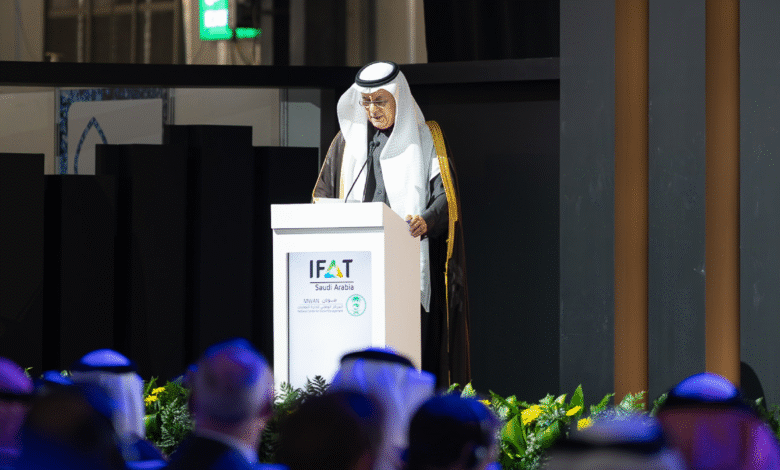
His Excellency the Minister of Environment, Water and Agriculture, Eng. Abdulrahman bin Abdulmohsen Al-Fadley, affirmed that the Kingdom of Saudi Arabia views the environment as an integrated development framework that directly impacts public health and keeps pace with economic growth ambitions. Within this context, the ambitious Saudi Vision 2030 has played a pivotal role in rebuilding the environmental system and making sustainability a shared pathway in the national transformation journey.
This came during His Excellency’s address today at the opening of the IFAT Saudi Arabia 2026 Conference and Exhibition, held in Riyadh, with the participation of leading figures in the circular economy, decision-makers, experts, and investors from around the world.
Eng. Al-Fadley added that the conference is being held at a critical stage that requires shifting efforts from fragmented solutions to comprehensive, long-term approaches. Hosting this event reflects the Kingdom’s firm belief in its growing role in supporting environmental action, exchanging expertise, building partnerships, localizing advanced solutions, and accelerating the adoption of best practices across the environment, water, and waste management sectors. These efforts further reinforce Saudi Arabia’s position as an active regional and global partner in advancing sustainability.
He noted that the water sector in the Kingdom has undergone a qualitative transformation, becoming an integrated system covering the entire value chain—from production, transmission, and distribution to treatment and reuse—within a model that reflects regulatory maturity, strong governance, and an attractive investment environment. Total water production capacity has exceeded 16 million cubic meters per day, with seawater desalination forming the backbone of supply. The private sector has contributed approximately 4.4 million cubic meters per day through public-private partnership projects. In addition, the Kingdom operates one of the world’s largest water transmission networks and reuses nearly 33% of treated wastewater, supporting environmental sustainability and improving resource efficiency.
His Excellency explained that this progress in the water sector is part of a broader, integrated environmental approach aimed at aligning economic growth with ecosystem protection. The significant transformations within the environmental system have enhanced planning and implementation efficiency, strengthened compliance, and reinforced a collaborative institutional approach. These efforts led to the launch of the National Environment Strategy and the activation of the Saudi Green Initiative as a comprehensive national framework, through which more than 500,000 hectares of degraded land have been rehabilitated, over 151 million trees have been planted, and the coverage of protected terrestrial and marine areas has increased to approximately 18% of the Kingdom’s total area. Saudi Arabia continues to advance steadily toward achieving Vision 2030 targets, including reaching 30% protected area coverage.
He further highlighted that the world is experiencing rapid population growth, leading to increased waste generation, making waste management one of the most critical pillars of environmental and economic sustainability in the coming phase. National indicators show that waste generation in the Kingdom has exceeded 130 million tons annually, transforming waste management from merely an operational challenge into a real opportunity to redesign value chains, convert waste into value-added resources, support the circular economy, and enhance resource efficiency.
The Minister of Environment explained that the Kingdom has established a national regulator for the waste management sector, developed a clear legislative and regulatory framework, and built an integrated planning system covering all stages of the value chain—from collection and treatment to recycling and final utilization. The waste management investment ecosystem has launched more than 500 investment opportunities, with an estimated value reaching hundreds of billions of Saudi riyals over the next 25 years, supported by infrastructure exceeding 900 facilities across the Kingdom, in partnership with the private sector.
He expressed his hope that this conference will serve as a launchpad for high-impact partnerships, meaningful investments, and practical solutions that contribute to advancing waste management systems, supporting the circular economy, and building a more efficient and sustainable future for the environment, the economy, and society.